What hololive production values most is its relationship between talents and fans - a connection sustained by the community and the messages shared by fans.
Most of the comments sent through livestreams or social media provide encouragement for talents and motivate them to keep moving forward. However, some messages can cause emotional harm or infringe on their privacy.
“Did something controversial happen?”
“Who’s behind that VTuber?”
“What’s their past life?”
Behind the scenes, it is the moderation team that quietly monitors such conversations to keep the community safe. At COVER, the moderation team operates entirely in-house, monitoring content around the clock, 365 days a year. The team’s responsibilities include monitoring comments on livestreams across video platforms such as YouTube and Twitch as well as managing anti-defamation measures on social media and major online forums. It also provides multilingual coverage, including Japanese, English, and Indonesian, and other languages depending on the region.
With over 70 talents and a multilingual environment where both streams and comments are delivered in various languages, how did COVER come to establish such a robust moderation system? We spoke with O and W from the Legal and Intellectual Property/Crisis Management Department, who oversee the moderation team, to learn about the team’s formation, the unique strengths of COVER, and their passion for their work.
The Moderation System That Grew Alongside Our Streams
――Today, the moderation team has become an essential part of the production,but when did the company first begin moderating streams?
Our talents at hololive production began streaming in 2017, but it was in 2020 that we officially started developing a full-scale moderation system. At that time, “moderation work” itself wasn’t widely known, and I’ve heard it was quite difficult to even recruit people for the role. When I joined the company in 2022, our domestic moderation coverage was still limited – operating from 10 a.m. to 2 a.m., and for some of our hololive EN and ID talents, we were relying on external partners. The first mission I received upon joining was clear: “Make it 24 hours.”
――Is having a full-time moderation system truly that important?
Since our talents stream at all hours of the day, it is important to ensure that they can stream safely and that users can comment comfortably at any time. After setting up an internal structure and recruiting new staff members, we started monitoring streams 24/7 from January 2023.
When I first joined the company, I actually tried doing the moderation work myself, and I remembered being surprised by just how much our moderators have to handle each day.
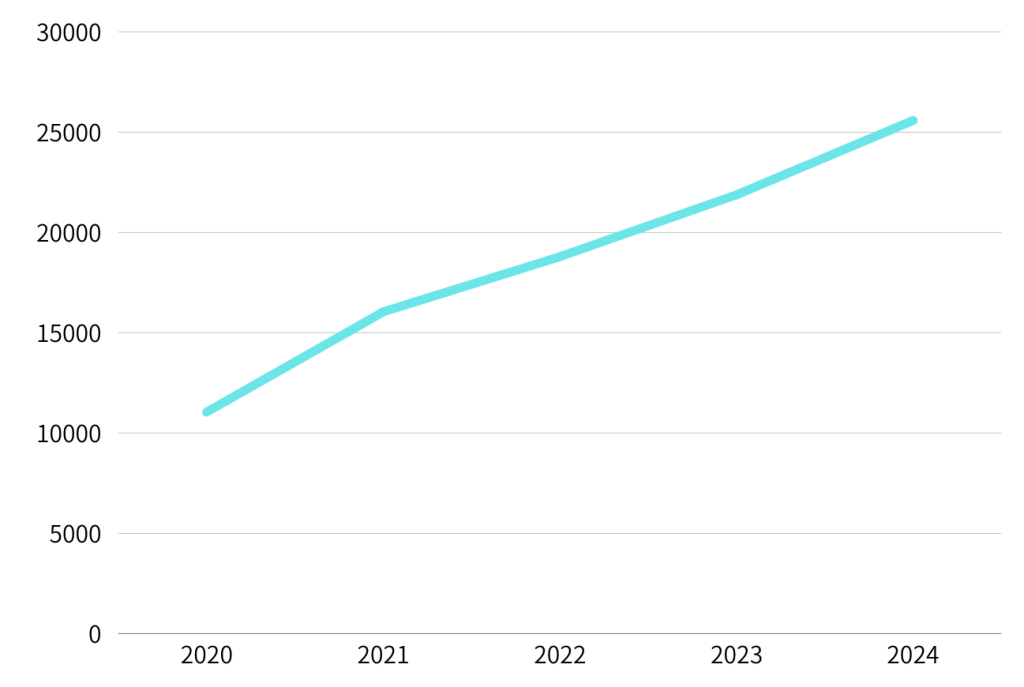
I joined the company slightly earlier than O. At that time, the number of talents was increasing rapidly and naturally, so was the number of streams. You can really see this growth from the numbers: in 2020, when the moderation system was first being established, there were about 11,000 streams. By 2022, this number had surpassed 18,000. To accommodate this, we needed to recruit additional staff to cover all hours of the day, including late-night slots.
I still remember when we announced a large-scale recruitment drive on Twitter (now X) in November 2022 – the response was overwhelming. Many applicants expressed genuine enthusiasm and passion for hololive production, for which we were truly grateful. We carefully reviewed every application and resume, and reached out to those who we felt truly understood the mission of our team. That group became the foundation of our current moderation team, which, by 2023, had grown to over 50 members, and today, we’re close to 80.
――Could you tell us about the strengths or unique characteristics of the current moderation team?
One of our biggest strengths is flexibility – all moderators are directly employed by the company. When outsourcing, it takes time for information to be passed from the vendor to our on-site staff, but with an in-house team, however, we can immediately share information and respond right away when something happens. Our team operates on a 24/7 basis, monitoring even when our talents are not streaming. During those times, we focus on YouTube comment sections rather than live chat, and once a stream begins, moderation activities start immediately.
Since everyone in the moderation team is directly employed by the company, we’re able to communicate closely with each individual allowing for precise and immediate feedback: for instance, when determining whether moderation has gone “too far” or not. This kind of quick feedback leads directly to improvements, and I think this is one of the key strengths of our moderation team.
――Is it possible to adjust the level of moderation based on the preferences of each talent?
Yes. While we maintain the core principles of the moderation team, we also receive feedback and requests from talents. In some cases, we review those requests and consider incorporating them into the overall moderation manual.
When we notice something, we sometimes reach out to the talent directly ourselves. Talents can also contact us through their talent manager, who then shares information with our on-site team. Our moderation team communicates using a platform that’s separate from the company’s main system, which helps minimize the risk of information leaks during these exchanges and even livestream monitoring for hololive EN and ID, which was previously outsourced, is now conducted entirely in-house by dedicated teams for each production, both on a 24/7 basis as well.
Ensuring Healthy Communication
――How did you manage to build a moderation system that works across different languages and cultures?
We’ve been truly fortunate – the members who first joined our EN and ID teams were exceptional. They embraced our approach to moderation, shared it across their teams, and helped build such strong, well-balanced groups. When it comes to non-Japanese comments, understanding cultural context is crucial. Even comments that seem appropriate at first may require nuanced interpretation, and our moderators provide detailed feedback and explanations in such cases. We even learn new slang or phrases unique to each language from them which would not be possible without having these moderators employed in-house.
――We’ve heard that you also use software developed internally.
Correct. We’ve developed a tool specifically designed for our moderation operations. These tools enable centralized management of all streams requiring supervision and allow for immediate responses to sudden influxes of malicious comments.
Without directly accessing a talent’s channel, moderators can perform various actions from within the tool – such as batch operations, fine-tuning settings for individual talents, and more – all while minimizing the risk of accidents or information leaks. The system also tracks when and how each talent’s stream is conducted and whether it follows our internal streaming guidelines, which our operators review manually as part of the moderation process.
By automating these tasks, we can focus our human resources on areas that require a high-level of judgement; thus creating a balance between precise technological processes and the careful attention needed by human moderators to check streams proficiently.
――What do you consider most important in moderation work?
I believe our most important mission is to create an environment that enables talents to perform at their best and fully engage with their audiences. We collect feedback from multiple sources, carefully evaluate the context, and remove comments that are deemed harmful. However, we also believe that moderation needs to be balanced and requires discretion. It is not ideal to just simply remove all but positive comments, as every comment has its own significance and impact. We value the dialogue between talents and their viewers and intervene only when necessary to maintain a healthy and respectful communication space.
――It sounds like creating an environment where open dialogue can thrive is something you value deeply.
Yes, that’s right. When supporting talents, we must be careful not to adopt an overly negative attitude toward comments. Behind every comment is a real person – a viewer. Moderators have the power to remove someone from a stream entirely, and it’s important to always be aware of how significant that authority is. While we strive to support the talents, we also make sure that our actions never cross the line into any form of excessive control over speech. Whenever we are uncertain about making a judgement call, we refrain from taking immediate action.
Of course, this never means we let certain comments slide. Comments fly by at incredible speed during a stream, but our system allows us to review and address them after the fact. When a case is ambiguous, moderators bring it to our immediate attention and we then make the final decision as accountable employees. Any form of hesitation means that it is not a black-and-white decision, and such cases require particularly cautious evaluation because a stream is, first and foremost, a place for talents and viewers to communicate, and we’re always trying to be mindful not to overstep.
The core principles for moderators at hololive production are very simple: “Respect what our viewers have to say” and “Always try to find a reason to keep a comment whenever possible.”
While it may seem simple to identify potential sources of controversy or harmful remarks and respond accordingly, such work has become increasingly complex in light of recent social diversity. A statement that feels normal to one person may still hurt another, meaning that moderators are required to engage with all cases carefully, precisely, and calmly.
Our goal is to create a space that feels like a one-on-one conversation between the talents and the audience. To make that possible, the ideal situation is to remain as unseen as possible. We’re invisible most of the time, but when necessary, we step in. If we can continue to be a kind of quiet, shadow-like presence, we’d be truly happy.
In a Constantly Changing Online World
――It sounds like moderation requires careful and nuanced judgement. How is training and development conducted for the moderation team?
Since moderation involves complex and multidimensional decision-making, we conduct on-the-job training using an internal analytical tool that compiles past cases. All incidents and responses are organized in our manual, allowing new moderators to search for various examples and learn how different situations were handled. Of course, it is difficult to learn everything at once, so new members are trained to access and utilize this system whenever an issue arises. They then continue to gain practical experience on a day-to-day basis.
Since all of our moderators are directly employed, we are able to provide personalized and detailed feedback to each individual ensuring that new members can quickly reach the same level of skill and understanding as our experienced moderators. Given that online topics evolve rapidly, we also proactively share information about emerging issues or areas that may require attention. Although such information may not always be immediately useful, having prior knowledge makes it much easier to handle a situation when the time comes.
In some cases, we introduce moderators to other roles within the company. We hold one-on-one meetings with each moderator every three months, and since many of them are still university students, our conversations often touch on their future career paths. When we find someone whose skills or interests align with another area of the company, we sometimes connect them with different departments. In fact, a few of our current employees originally started out as moderators.
――The online world that the moderation team faces is changing every single day. How do you feel about these constant changes?
The internet is certainly changing every day, but I believe that communication between people never really changes. As a moderation team, it is important for us to consistently stay on top of new developments so that we can integrate both traditional and modern approaches into our work. Moderation is not a role with easily definable goals or visible results, but we occasionally receive messages of gratitude from talents. Whenever that happens, we make sure to always share them with the team to help maintain an environment where staff members feel a genuine sense of purpose and satisfaction.
Everyone on the team is really motivated and engaged in their work.
――Lastly, is there anything you’d like to share with everyone who supports hololive production?
Thank you so much for all the chats and comments you send us. Streams exist because of the fans who support them, and your words of encouragement reach the talents directly. Some of you may find yourselves wanting to know everything about the talents you love. At the same time, I’d like to remind everyone that what we want you to enjoy most are the performances right in front of you, the moments they share with you here and now. We’ll keep doing our best to protect this environment where that connection can be felt in real time.
No matter how fast comments are being exchanged, our talents are always reading what you share and we are truly glad that you continue to love and support them. As the moderation team, our role is to help continue to make that possible – to support an environment where you can keep enjoying and caring for them.
Thank you so much for continuing to support hololive production.