In Part One of this special feature on COVER Corporation’s music business, we took a close look at the production of the EPs, “Re:Start” and “Re:Birth,” released in November 2025 by hololive production’s AZKi, and interviewed AZKi herself about the emotions put into her solo live "Departure."
In Part Two, we hear from COVER employees in solo live production (O and H) whose job it is to maximize the fan experience.
Accurately Portraying Talents’ Feelings and Maximizing Emotions: Behind-the-Scenes with Live Production
―First of all, could you give us an overview of solo live production at COVER?
COVER looks after everything from live (concert) planning to production, management and sales, while receiving help from partner companies. For “Departure”, over 20 companies were involved.
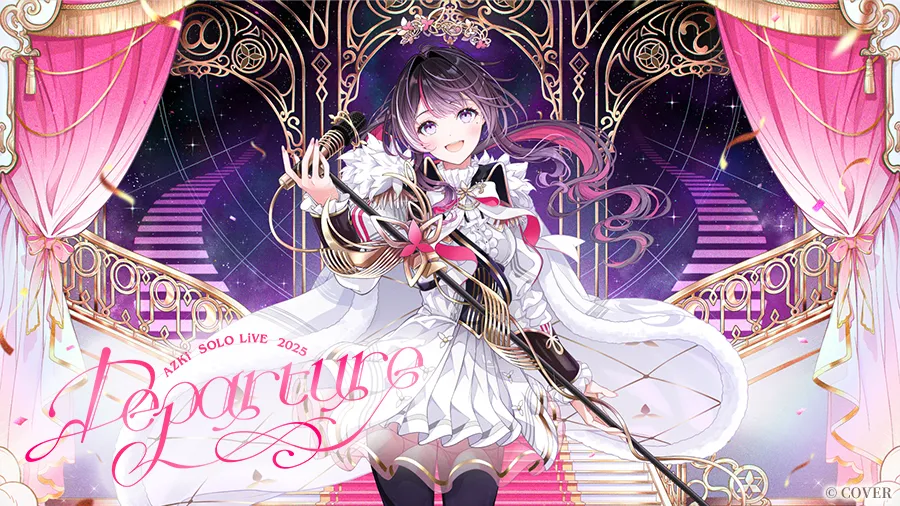
There are currently around 20 members involved with live production in COVER, who are divided into different project teams to coordinate each live performance. Production teams, including our partners, reach out to other partners who can express on-stage worldviews and concepts talents wish to showcase.
―In that case, how many people are then involved in a single performance?
Internal employees are involved in many different ways, with some dedicating a lot of time and resources to one performance, while others handle work only when necessary. For Departure, we had a total of 60-70 people involved, including those from within and outside the company. In terms of departments, I can say that almost every department internally is involved.
―So, using “Departure” as an example, take us through the process of creating a live production.
First of all, we held a meeting with AZKi and started by listening to what her feelings were and what she wanted to express on stage for this performance. Then, we took keywords from AZKi and extracted a narrative that would become the foundation of the story for the live performance.
From there, we would plot a setlist and structure, visualize the performance in the form of documents, and then confirm the content and setlist while being in constant dialogue with AZKi.
Following that, we held meetings such as those regarding production and lighting, as well as with the filming director concerning camera work and designing the performance so that each part of the performance is meaningful. “Departure” featured a live band, so it was important for the producer to decide on the performers and how the songs would be structured, in addition to the direction of the arrangement as well.
―With this performance being AZKi’s biggest performance to date, there were many new fans who came to see her in addition to fans who have supported her up until now. What did you consider to ensure both sets of fans enjoyed themselves?
I feel like this was particularly evident in the setlist and production. With the setlist, we told a story by having the songs in order from earliest releases to her latest tracks.
When representing AZKi’s seven-year journey, we displayed each of α, β and γ with decorations up above so that each one was easily distinguishable. This showed the important elements, or routes, within her activities, which are very familiar to all kaitakusha (pioneers―the name for AZKi’s fans). We represented the struggles AZKi is carrying by choosing songs that symbolize each route and showing off AZKi’s current form.
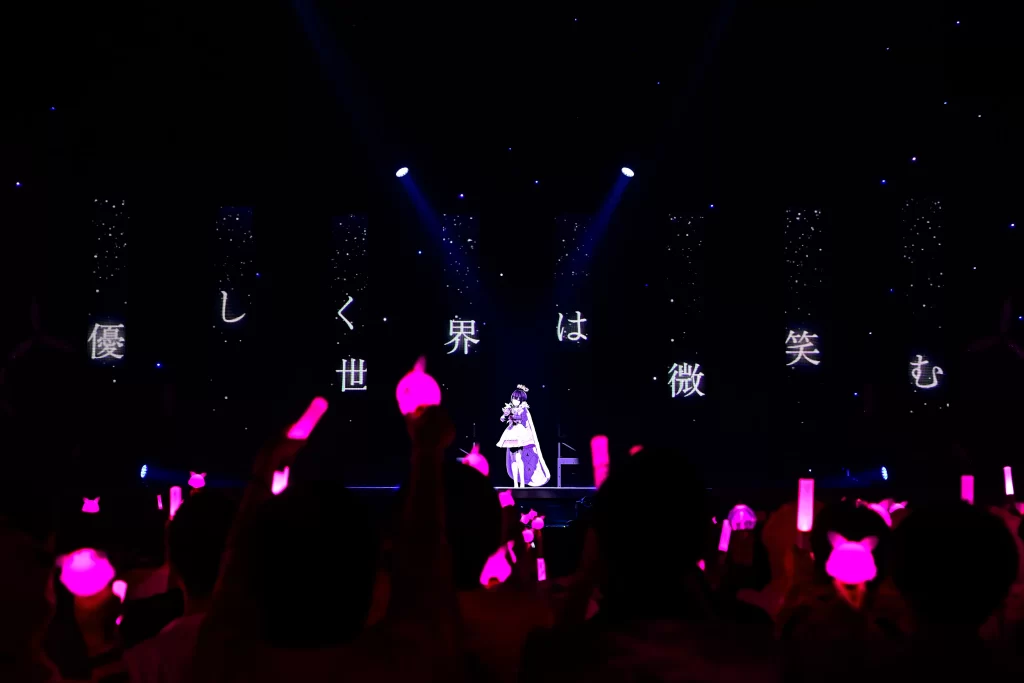
However, if it just ends with that, then it will just appear like a simple goodbye or she is disappearing, potentially leaving people with a sad impression. The visual effects we went for was having past AZKi represented as beams of light blending into the stage and then we gradually had flowers blossom across the stage, with the aim of symbolizing the growth process for her as a solo artist.
Then to add to that, we decided early on to have violins playing as well. Through this kind of production, we were able to create a live experience like no other, by bringing out a new layer to her past songs as well. This was probably the first time violins were used at a hololive production live event as well.
The Appeal of Livestreams and Venues
―In general, hololive production music events are livestreamed, but what production/services do you take into account for overall live events?
Rather than give the exact same experience for venue-goers and those watching online, we try and consider other ways to enjoy the event. In order to do so, as well as, of course, making sure that the talents movements and expressions are clearly visible, we prioritize showing other aspects that can only be seen on stream.
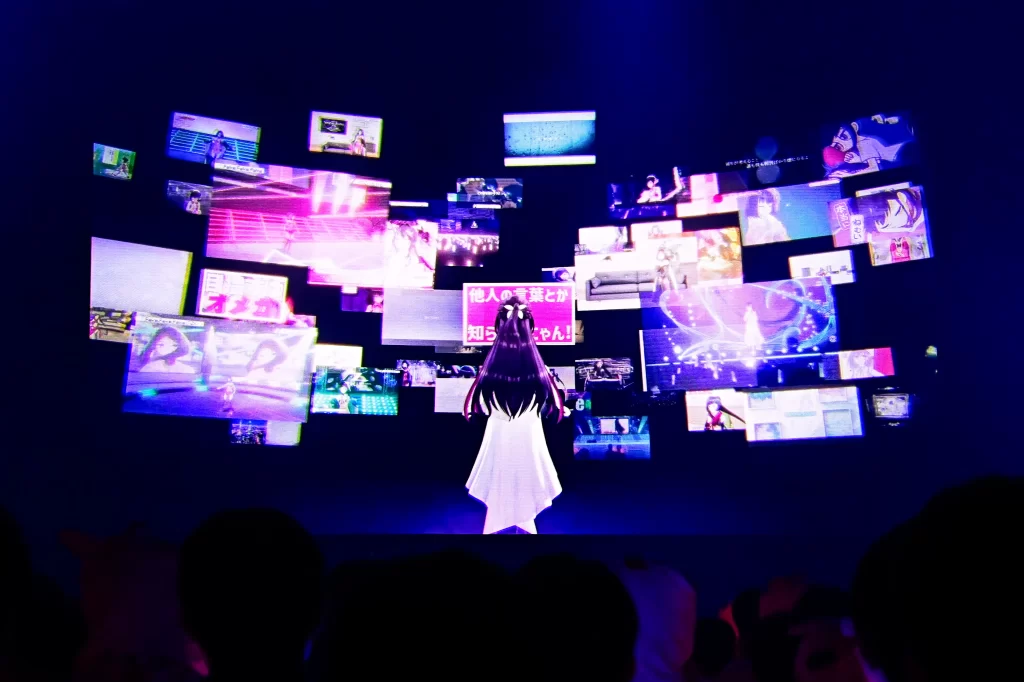
To give an example, with “Ame nochi Harebare” sung during “Departure,” there are visuals of past AZKi quickly running past. On stream, these visuals are a semi-transparent layer over the top of current AZKi who was actually standing on stage, with viewers able to see both at the same time.
At the venue, how the audience sees and hears the performance depends on where they are located, but on stream, we put considerable effort into delivering almost 100% of what we wish to convey through any given live show. Regarding camera work as well, we go through the entire show before the actual event with the director of filming, the person who decides on framing and shot composition and there is always direction from the producer for every song, such as “we would like to capture the start of the chorus for this song with a moving camera,” or “the choreography for this song is really impactful so we want close-ups.”
By the way, there are 3 main types of cameras used for livestreaming. The first are cameras set up at the venue to capture what is happening at the venue and on stage. The second are known as “virtual cameras,” and are those used for talents’ 3D anniversary livestreams. Last but not least are AR cameras, which capture actual footage from the venue and combine it with AR (augmented reality).
For example, the feel of footage taken using virtual cameras is slightly different to that from those set up at a venue, so switching between them can disrupt the viewing experience. Therefore, we add in AR cameras in between these other cameras to reduce any such disruptions.
―So livestreaming is not merely just an alternative to going to the venue, but has its own appeal. Very interesting! On the other hand, what experiences can you only get at venues?
Firstly, what is rather important is the fact that fans are in the same space as talents. Experiencing the same atmosphere and experiences in real time is something that can only be done at venues. During a regular stream, viewers leave comments to which the talents react, but live venues are also places where fans’ cheers reach their oshi directly.
―So there is call & response during songs and emcee parts during these performances. Also, as we saw during Shirakami Fubuki’s 1st solo live “FBKINGDOM ‘ANTHEM’,” and Houshou Marine’s 1st live “Ahoy!! You’re All Pirates♡,” sometimes there are warm moments like fans spontaneously singing to the instrumentals playing during the end credits.
There are many kinds of appearances at VTuber live events, but for COVER-organized shows, the talents themselves come to the venue and stand on stage. Therefore, the talents can hear their fans’ actual voices, so pleased be reassured that your feelings are truly being felt by the talents on stage.
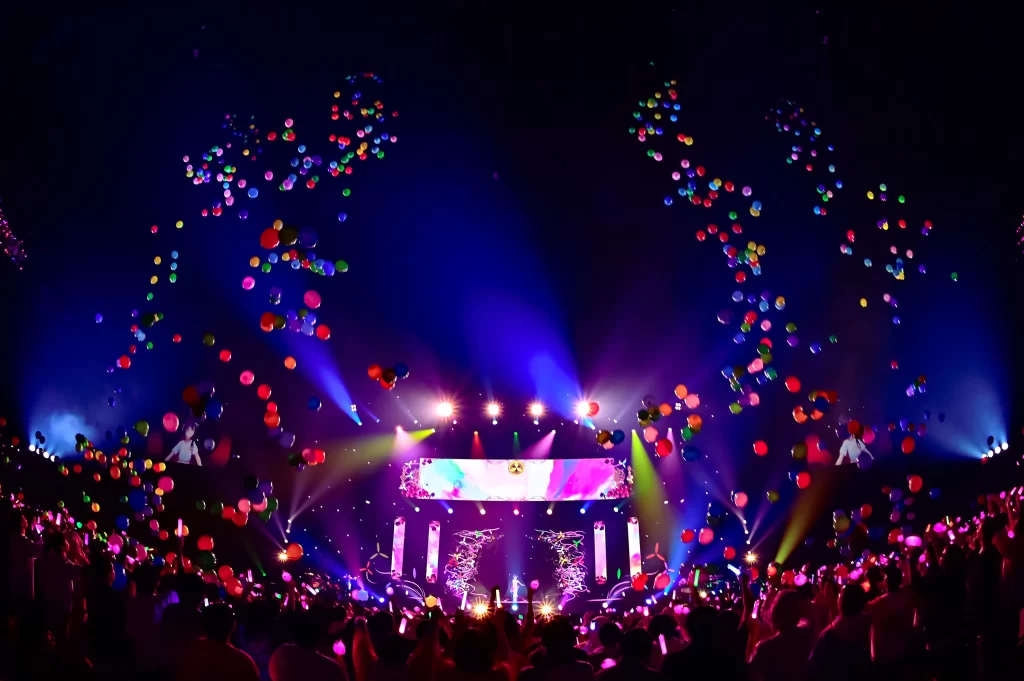
―H, you just mentioned moments ago about “experiencing the same atmosphere and experiences in real time,” but do not only the fans but dthe talents also enjoy this aspect of performing live?
For sure. These are extremely valuable and irreplaceable experiences for the talents themselves as well, because it is not often that so many people who love you come to the one place to watch you up on stage.
―What do you pay particular attention to as someone who has been involved with many live events up until now?
We are particularly mindful of creating a real sense of immersion for the audience. Our mission is to make our audience feel emotions that can only be felt at live shows, while also looking back on a talent’s activities up until that point, by incorporating what we want to convey to fans in how the show is structured and its setlist, as well as consistently creating the ideal stage for talents to perform all of their musical releases to date.
It is also integral that we continue to display each talents’ goals and worldviews in innovative and original ways. This also goes for the sense of immersion as well, but it is thanks to everyone who watches hololive production live music shows that they are able to continuously evolve.
“Departure” Official Report : Here (available in Japanese only)